

Myopia in the Classroom: Teachers Share Their Experiences
Myopia among children is on the rise worldwide (3)—and with it, the challenges faced in everyday school life. Every day, teachers observe how vision problems affect students’ academic performance, concentration, and well-being. (15,16,19,20,22,31)


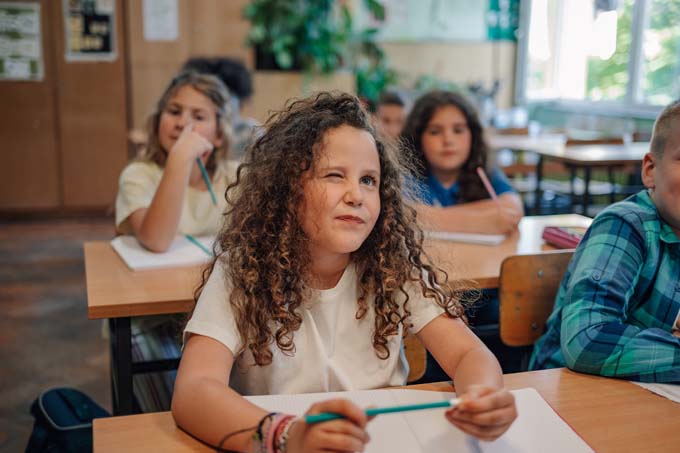
Experiences from the classroom show how important good vision is for children’s development. (9) We surveyed teachers who shared their perspectives on managing nearsightedness in everyday school life.* Their comments highlight why early education, appropriate vision aids, and flexible solutions can play an important role for children.
Here's what the teachers have to say:
Dealing with Early Vision Problems
„You can usually tell relatively quickly if a child has a vision problem. The children say they can’t see anything, and they squint or narrow their eyes when copying something from the board. In such cases, we advise parents to take their child for an eye exam.“ Steffi K., elementary school teacher.
„When I notice that a child is having trouble seeing the blackboard or whiteboard, I speak with them directly. If necessary, I also inform the parents. Last year, I had a student who, despite wearing glasses, couldn’t even read large print—even though she had seen an eye doctor just six months earlier. After I brought this to the parents“ attention, she got a new pair of glasses. Her nearsightedness had worsened so quickly that she needed new lenses by then.” Wiebke M., high school teacher.
Practical Challenges with Vision Aids
„As a rule, we don’t have to pay special attention to children who wear glasses. However, I notice time and again that students who wear glasses tend to forget them at home quite often. Young schoolchildren in particular have a hard time wearing their glasses consistently—whether because they forget them or because they don’t like them.“ Anja K., elementary school teacher.
„I talk to the children about how to handle their glasses: where to wear them and whether they should wear them, for example, during physical education or recess. For new glasses wearers, I take the time to explain how best to handle them.“ Nadine E., elementary school teacher.
Contact Lenses: A Topic for School?
„I’ve generally noticed on several occasions that some children wear contact lenses, but more by chance. So far, I’ve never been specifically told about it. Sometimes I notice when a child who usually wears glasses suddenly isn’t wearing them anymore because they’ve switched to contact lenses.“ Wiebke M., high school teacher.
Good Vision = Better Performance?
„Of course, vision plays a very important role in the classroom, since a large portion of information is conveyed through sight! Unfortunately, we often don’t realize until it’s (too) late that a child’s vision isn’t good enough. Children unconsciously develop strategies to avoid drawing attention to themselves—for example, by participating less or appearing unfocused.“ Anja K., elementary school teacher.
„From my own experience as someone who has dealt with this issue, I know that good vision is a major factor in students“ academic success, because classroom instruction today is characterized by a wide variety of visual teaching methods. If I notice that (especially young) schoolchildren are repeatedly inattentive during general classroom discussions, I would always point this out and recommend having their vision checked—or, if they already wear glasses, having them checked to see if the prescription is still correct.” Linn H., student teacher preparing for her exams, tutor, and nearsighted herself.
Self-Confidence & Social Experiences
„In my opinion, wearing glasses can affect self-confidence. Many children, especially during puberty, are very critical of their own appearance; they don’t feel comfortable wearing glasses or are afraid of being excluded. With contact lenses, for example, their appearance doesn’t change—so their self-esteem isn’t diminished as a result.“ Corinna K., comprehensive school teacher.
„I rarely see bullying related to wearing glasses—that’s an outdated narrative, since more and more schoolchildren are wearing glasses. Some children are happy to wear their new glasses right away because they can see better with them. Others (mostly in elementary school) have complained because it’s annoying to constantly put their glasses on and take them off, the frames feel unfamiliar, or they’re afraid of teasing or comments from their classmates.“ Linn H., a student teacher preparing for her exams, a tutor, and nearsighted herself.
Sports & Vision Aids: Glasses vs. Contact Lenses
„In physical education class, children are allowed to wear their glasses as long as they fit properly. However, in contact sports or fast-paced games, it may be necessary to take them off—which puts nearsighted children at a disadvantage. Contact lenses would be a sensible alternative here, since they’re less of a hindrance and don’t pose an additional risk of injury.“ Franziska R., comprehensive school teacher.
„Ideally, special sports glasses would be useful for physical education classes, but they’re rarely available. That’s why many children participate while wearing their regular glasses. Although these are now very sturdy, there’s still a certain risk—and the fear—of getting hit in the face by a ball or an elbow. Without corrective lenses, however, nearsighted children would be at a significant disadvantage and would only be able to participate in many exercises—especially ball games—to a limited extent. Contact lenses could be a viable alternative for these children if they can adjust to them.“ Oluf M., middle school teacher.
Conclusion: Good vision is more than just a matter of visual acuity
The experiences of the teachers surveyed clearly indicate that myopia in children is no longer a marginal issue in everyday school life. It affects not only academic performance but also students’ concentration, self-confidence, and social participation—both in the classroom and in physical education classes.
What is particularly striking is that contact lenses and modern myopia management have played virtually no role in everyday school life to date. Many teachers, however, see potential in them—whether as a practical alternative during physical education, to make everyday life easier, or to boost self-confidence during sensitive developmental stages.
What the voices from the classroom make clear:
- Early detection is crucial – Many children unconsciously compensate for their vision problems.
- The right vision aid must be suited to the child's daily life – not the other way around.
- Information on modern alternatives such as contact lenses (e.g., MyDay MiSight 1 day) and Myopia management should receive greater attention—from parents, children, and teachers.
Good vision is essential for successful learning and healthy development. For children to reach their full potential, we need greater awareness, better education, and flexible solutions that go beyond traditional eyeglasses.
Source: www.coopervision.de