

IVBS 2026: Conference on Binocular Vision
The 38th Annual Congress of the IVBS (International Association for Binocular Vision) focused on presenting practical content. In addition, the Hans-Joachim-Haase Prize was awarded again for the first time in nine years.


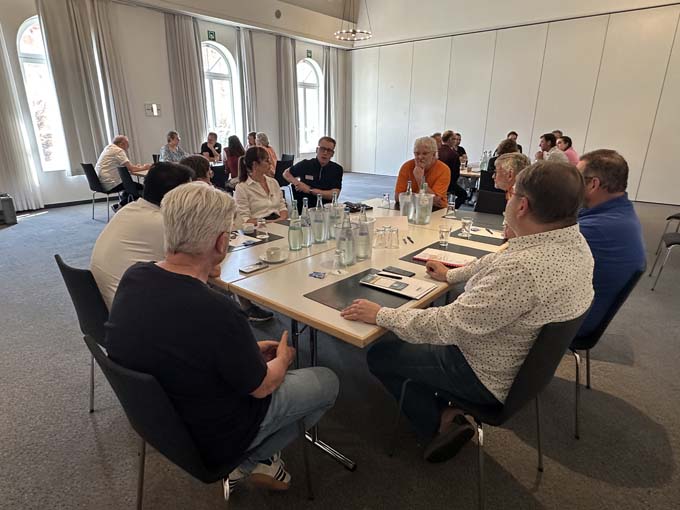
The conference began on Saturday with seminars, all of which were well-attended. For more information on the seminar topics, visit www.ivbs.org under „Continuing Education.“ The now-established „roundtable discussions“ were also offered again, and many participants took advantage of them to discuss the three scheduled topics at the three designated tables. Since there were many long-time MKH users with practical experience among the conference participants, an intensive exchange took place, and everyone was able to learn a great deal from one another. Young participants benefited just as much from the discussions as the “old hands.” In the evening, as usual, the annual general meeting of IVBS members and the group dinner took place.
On Sunday, the president opened the conference with a summary of the IVBS’s latest news and plans, and moderated the day’s proceedings, which included the following eight presentations and the awards ceremony.
Educational Activities on Binocular Vision
Jan Dominiczak delivered the opening presentation on Sunday morning on the topic „Reaching Millions for Better Vision—How Binocular Vision Ensures Educational Opportunities and Repositions the Optometry Industry.“ In his presentation, the speaker discussed the importance of educating the public about binocular vision. Using reach figures and audience comments, he highlighted the impact that binocular vision problems have on education, daily life, and quality of life. In 2025, with the help of his son, he also launched a YouTube channel called „Parents Raise Successful Children.“ Using an example, the former elementary and middle school teacher illustrated how the right pair of glasses could make life easier for a student, who was thereby able to overcome his binocular vision problems. Conclusion: Prismatic eyeglass correction can eliminate visual deficits and turn a supposedly poor student into a successful one.
Visual Performance Parameters
In his presentation, Bernhard Peuckert introduced a test procedure designed to detect disorders of binocular vision. At the same time, co-presenter Christian Kochniss provided a practical demonstration of the tests.
Visual performance parameters (VLP) have long been recognized through the OEP 21 (Optometric Extension Program) and integrative analysis (according to Scheiman and Wick). The method for measuring visual performance parameters demonstrated by the speakers also highlights the success of prismatic corrections. Through training seminars funded by the IVBS, interested opticians and optometrists were instructed in and practiced the procedure for standardized data collection; a phoropter is not required for this. The test results were recorded in the measurement protocol developed for this purpose. The IVBS will have the collected data sets evaluated in order to demonstrate the success of the respective measures taken through changes in the VLP.
Objective Fixation Disparity Under the Microscope of Retinal Imaging
Maximilian Freiberg investigated whether our eyes are truly perfectly synchronized when we look at an object and whether they actually focus on the exact same point.
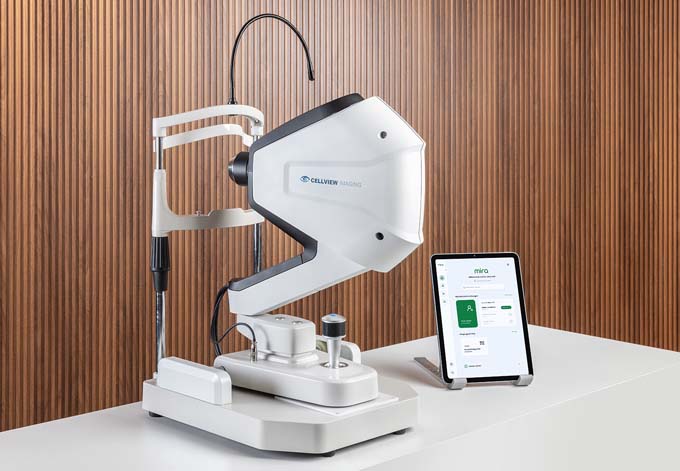
Research on objective fixation disparity (FD) shows that a minute motor convergence error often exists, even when a person’s perception is stable and straightforward. For a long time, however, these minimal deviations were masked by the measurement inaccuracies of conventional eye-tracking systems. The speaker presented new findings obtained using a binocular scanning laser ophthalmoscope (bSLO) that is unique worldwide. This technology makes it possible to no longer estimate objective FD only indirectly via the anterior segment of the eye, but to visualize and quantify it directly at the level of the photoreceptors. The study investigated how objective FD relates to classic clinical parameters, such as heterophoria, whether retinal image misalignment caused by „misuse of the Panum zones“ actually leads to poorer stereoscopic visual acuity, and what influence the complexity of the visual task has on fixation behavior at the microlevel.
MKH in the Eyes of Science
MKH has been used successfully for decades to provide prismatic correction for individuals with binocular vision problems. One indication of the international recognition of MKH is the fact that it is part of the examinations for the European Diploma. In his presentation, Volkhard Schroth presented the scientific perspective on MKH. To this end, he had closely examined scholarly articles on MKH from the past 30 years that were published according to recognized standards. The key findings were organized into thematic groups: theoretical concept and unique features, correction outcomes, stereoscopic functions, and insights into objective fixation disparity.
Treatment Options for Strabismus
Strabismus, or eye misalignment, has various causes. Dr. Robert Hörantner, an ophthalmologist from Austria, provided a brief overview of the most common conditions in this field, outlined the main conservative and surgical treatment options, and clearly compared them using graphical illustrations. The focus was on surgical options for simple and, above all, complex eye movement disorders, as well as on the preoperative simulation of the effects of changes in the position of the eye muscles.
Discussion of Technical Terms Related to MKH
The previously announced lecture by Prof. Robert Winn has been replaced due to a last-minute cancellation. In light of current discussions, Beate Göpel took this opportunity to address critical comments regarding changes to terminology and test names in the MKH guidelines. This focuses in particular on the terms fixation disparity, converse presentation, stereo delay test, stereo dominance test, stereo visual acuity test, as well as intermittent and fixed fixation disparity. Was this reasonable? Was this necessary? Why and for what purpose? The changes are clearly explained and justified. This allows the audience to understand why these adjustments were justified and necessary.
Contact Lenses for Prescriptions with Prism?
Tobias Ecke was able to answer this question unequivocally with a „yes.“ People with severe refractive errors and anisometropia benefit from wearing contact lenses. First, he explained why contact lens wearers experience fewer asthenopic symptoms than eyeglass wearers (without heterophoria correction).
Since contact lenses eliminate many of the aberrations caused by eyeglass lenses, the visual system’s need for motor and sensory compensation is reduced. The fusional compensation reserves thus freed up help the eye cope better with uncorrected heterophoria. The speaker then used case studies to illustrate how different client groups can benefit from contact lens fitting. Contact lenses offer clear advantages in cases of high ametropia and anisometropia. Similarly, in cases of irregular corneas, monocular vision should first be improved using contact lenses. If necessary, prismatic eyeglass lenses can be used to relieve strain on the visual system in cases where additional, symptomatic heterophoria is present.
Is it all orthodontics or what?
Since the field of optometry is constantly evolving—with standards being regularly revised, work guidelines being developed, and new approaches to addressing binocular problems being established—communication issues arise unconsciously, particularly in international and interdisciplinary technical language. Misunderstandings often result from differing interpretations of a single term. With his presentation, Michael Hornig aims to help improve communication within the field of optometry, as well as between optometry, orthoptics, and ophthalmology. It is important here that terms be used that have the same meaning for everyone.
Hans-Joachim Haase Prize
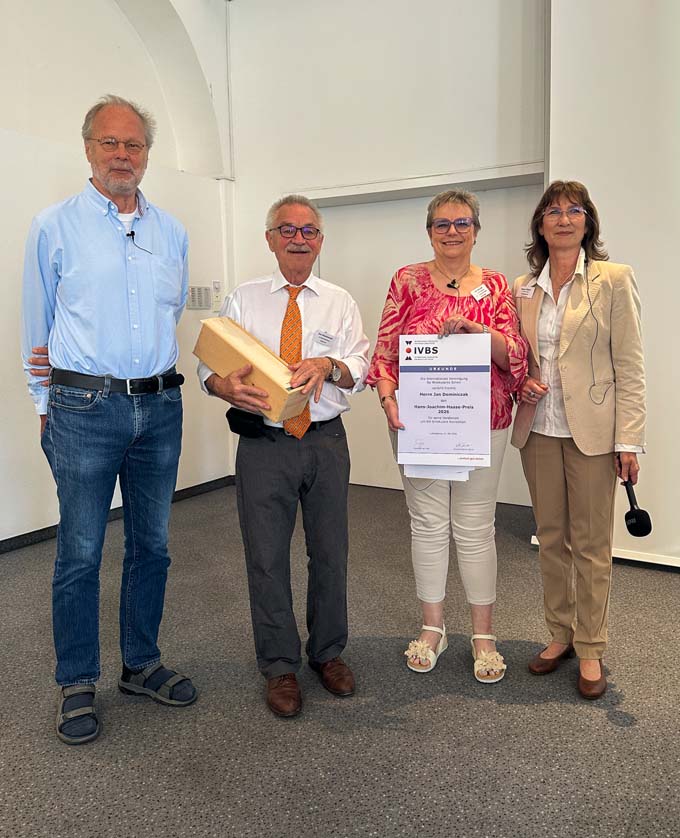
The Hans-Joachim-Haase Prize was established in the summer of 2002 to honor the memory of Hans-Joachim Haase and to promote his life’s work. This year, the prize was awarded to Jan Dominiczak, a former elementary and middle school teacher from Maulbronn, who has been educating students in schools about binocular vision and prismatic corrections for many years. He has since successfully expanded his educational efforts to include posts on TikTok and YouTube, which have been viewed millions of times. The laudatory speech was delivered by Elke Brandt, a member of the IVBS Scientific Advisory Board. Brandt emphasized that it was only through Jan Dominiczak’s educational work that she had come to engage intensively with pediatric optometry, and she thanked him for it. He was genuinely surprised to be the award recipient, as he had not been informed of this in advance. The award ceremony was also a very emotional moment for the audience, and Jan Dominiczak received a standing ovation.
During coffee breaks and lunch breaks, there was a lively exchange between participants and exhibitors. Because the exhibitor booths were integrated into the break hall, everything was within easy reach for everyone, which greatly facilitated communication. Even for long-time conference attendees, the four new exhibitors were very interesting.
Next year, the IVBS Congress will take place again in Siegburg on June 5–6.
Source and further information: www.ivbs.org