

Swiss vision habits in 2025: Four out of five wear vision aids
According to a long-term study by OPTIKSCHWEIZ, the proportion of people wearing glasses and contact lenses in the Swiss population has declined slightly but remains at a high level. According to the Association for Optometry and Optics, the reasons for this are the increasingly older population, the higher visual demands of the screen society, and the fact that children's eyesight is now tested earlier and corrected if necessary.


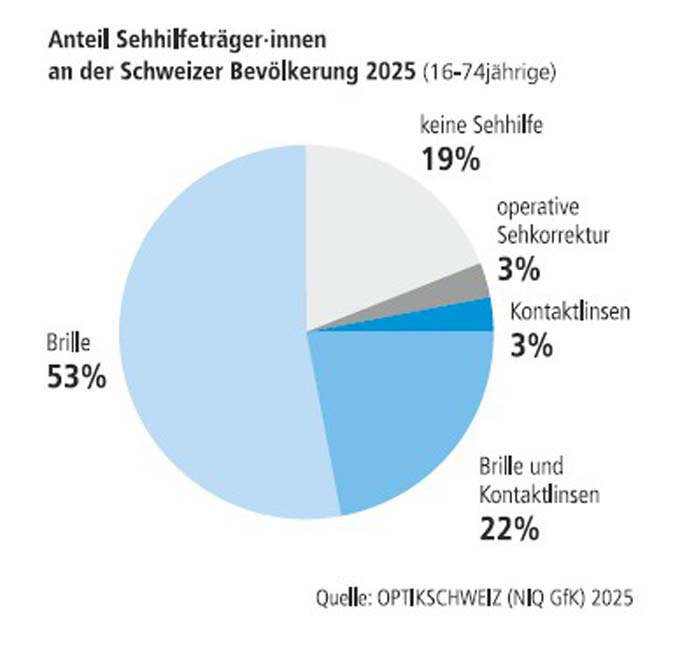
There are many reasons for the high proportion of people who wear visual aids in Switzerland. Demographic trends and an increasingly older population are contributing factors. Due to natural presbyopia (around the age of 50, the eye lens has increasing difficulty focusing on close objects), no one can avoid needing visual or reading aids in the long term. In the 55 to 74 age group, 89% wear glasses or contact lenses.
Smartphones and screens place demands on the visual system
The high demands and expectations of our highly visually oriented world often cause problems even for younger generations: everyday use of digital devices and constantly looking at close distances place enormous demands on the interaction between the eyes and the brain. Minor visual impairments, which the visual system can easily compensate for in everyday life, become noticeable under these conditions and require correction.
More corrected children and adolescents
Last but not least, children and young people today are undergoing more optometric examinations and receiving more corrective treatment than in the past. While in 2001 more than half of those aged 16 to 24 surveyed said they did not wear visual aids, today the figure is only one third. Good visual perception plays a key role, especially at school and in training.
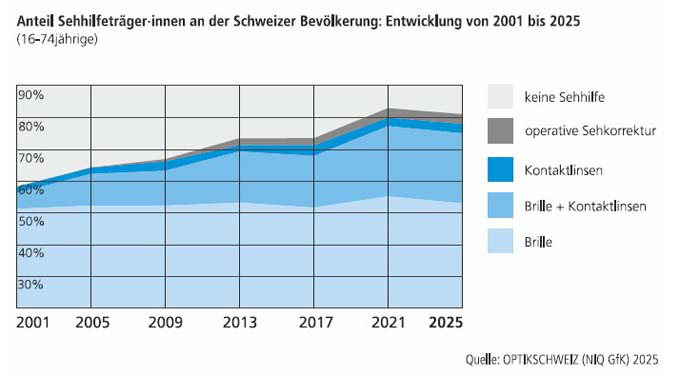
However, this study does not provide evidence of an increase in myopia, as predicted by warning voices in recent years. The distribution of the need for correction for near or far vision has remained relatively constant in the 16 to 24 age group over the last two decades. Regardless of this, it is important to warn emphatically about the consequences of regular, hours-long screen time for children and adolescents. During the growth phase, this can have a lasting negative impact on the development of visual acuity. Children's eyes develop best when playing outdoors in natural light.
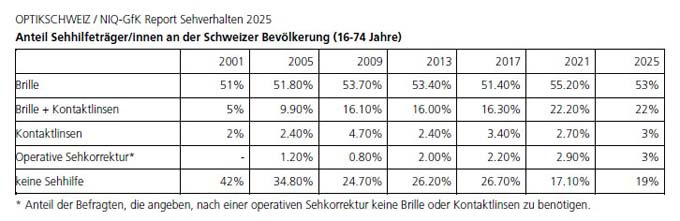
Since 1979, OPTIKSCHWEIZ has been conducting a survey on visual behavior in the country every four years in order to record long-term developments.
Detailed report for OPTIKSCHWEIZ members
The consumer survey, which was launched in 1979 under the name «Publitest,» is now conducted by the company NIQ GfK. The detailed report from November 2025 is available in German and French and can be downloaded by owners and managing directors of member companies on the extranet (see «Extras» > «Statistics»).