

Essilor Stellest 2.0: A Significant Advance in Myopia Management for Children
New H.A.L.T. MAX technology, simplified ordering processes, attractive services, and reduced prices make myopia management even more accessible for opticians and families.


Essilor introduces the new Essilor Stellest 2.0 eyeglass lenses, featuring the innovative Highly Aspherical Lenslet Target (H.A.L.T.*) MAX technology. Thanks to enhanced lens performance and asphericity, this new generation represents a further advancement of the original H.A.L.T.* technology, which was first introduced in China in 2020. A one-year clinical crossover study confirms the significantly higher effectiveness of Essilor Stellest 2.0 in slowing myopic eye growth compared to the first generation.†1
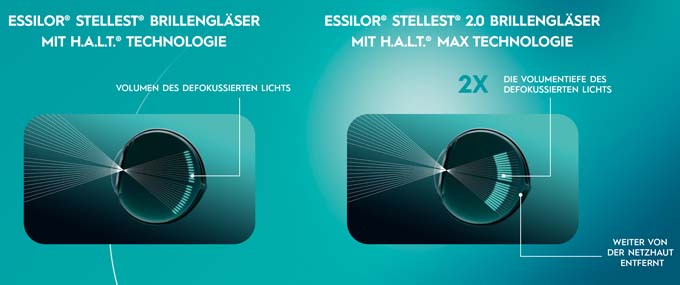
Millions of children worldwide have already benefited from the first generation of Essilor Stellest lenses, which have been proven to slow the progression of myopia by 67 %.‡2 The new version with H.A.L.T.* MAX technology offers a signal that is twice as strong,§ which allows for even greater inhibition of myopic eye growth compared to the previous version.1
„As long as myopia exists in children, we at Essilor will not stop developing new solutions,“ said Alexander Mohr, Managing Director of EssilorLuxottica Germany and Austria. „This innovation is our most effective product to date for myopia control.”“#1". Essilor Stellest has received the first—and so far only—FDA authorization for eyeglass lenses for myopia management. Wearers continue to enjoy the proven benefits of Essilor Stellest—clear, corrected vision without compromising on aesthetics or safety**—but with an added benefit†† and effectiveness‡‡1. This makes them the ideal choice for children with early-onset myopia.
Technological Innovations
Essilor’s ongoing research into myopia has led to this technological advancement. The R&D experts identified a correlation between the properties of the microlenses (lenslets) and the effectiveness of myopia control. Based on this, they developed an optimal balance between lens performance and asphericity—and incorporated it into the new design.
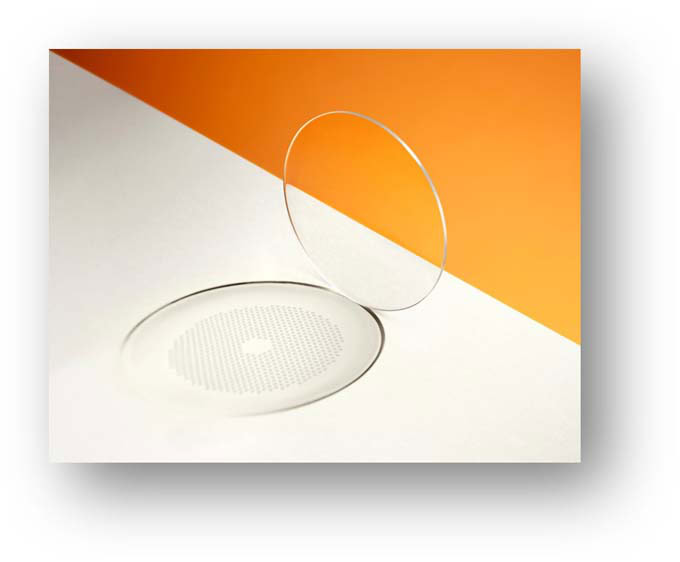
The microlenses are based on two key principles: increasing the average power and the degree of asphericity. This creates a volume of unfocused light that is twice as deep and farther from the retina—thereby generating a stronger optical signal that can slow the axial growth of the eye. In the new Essilor Stellest 2.0 lenses, the microlenses are distributed across 12 rings (instead of the previous 11), which increases the diameter and allows for a wider selection of eyeglass frames.
Clinical Trial
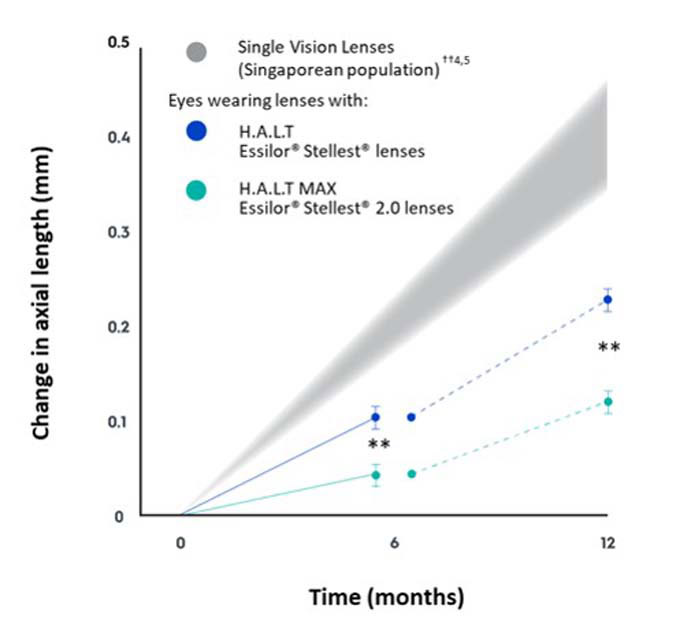
To evaluate the effectiveness of Essilor Stellest 2.0, a contralateral crossover study involving 50 children was conducted in Singapore. The results show that the new lenses featuring H.A.L.T.* MAX technology significantly slowed axial growth compared to first-generation lenses with H.A.L.T.* technology—both at 6 and 12 months.1
Joint Progress in the Fight Against Myopia
With the launch of Essilor Stellest 2.0, EssilorLuxottica aims to make myopia management even more accessible to opticians and families in Germany, Austria, and Switzerland. In addition to technological advancements, this includes automatically integrated services, simplified ordering processes, and new, attractive economic terms.
„This advancement would not have been possible without our myopia experts: They have been with us from the very beginning, contributing their expertise and providing us with valuable feedback based on their daily practice. We listened—and turned that feedback into concrete improvements,“ said Alexander Mohr.
EssilorLuxottica is thus sending a clear message: Purchase prices will be lowered, and at the same time, the manufacturer’s suggested retail price for end customers will be reduced. In addition, Essilor Stellest will be integrated into the multi-lens offering in the future, thereby creating additional attractive options for treating young patients with myopia.
In Germany and Austria, Essilor Stellest and Essilor Stellest 2.0 will always be offered with the Stellest+ service going forward. This service includes 100% replacement in the event of a change in prescription of at least 0.50 dpt, as well as 50% replacement in the event of breakage, scratches, chips, or changes due to anatomical factors. For Switzerland, a differentiated concept tailored to market requirements will be implemented.
At the same time, EssilorLuxottica is significantly simplifying the ordering process. Essilor’s myopia experts will now be able to order myopia lenses directly through their standard industry software.
The launch of Essilor Stellest 2.0 will be accompanied by a comprehensive training program. This includes a large-scale in-person training session for opticians on September 7. In addition, numerous training courses are available on the Leonardo online learning platform.
„Our goal is to make myopia management practical and economically attractive for as many opticians as possible,“ said Alexander Mohr. „Together with Rupp + Hubrach and Nika Optics, we’re laying the groundwork to ensure that even more children have access to modern, scientifically sound myopia management. We’re making myopia management more accessible to families—with fewer barriers, simpler processes, and affordable care.“
The introduction of Essilor Stellest 2.0 is therefore more than just a product launch. These eyeglass lenses represent 45 years of science-based innovation by EssilorLuxottica in the field of myopia control. The mission of Essilor Stellest is clear: children around the world should not be limited by their vision, but rather inspired by their possibilities.
Presentation of the Results from the Contralateral Crossover Study
Essilor Stellest 2.0 lenses with H.A.L.T.* MAX technology significantly slowed axial lengthening after 6 and 12 months compared to Essilor Stellest lenses with H.A.L.T.* technology.
§ The SVL (gray zone) is based on data from Singapore from the SCORM study³ and a clinical trial conducted in 2025,4 extrapolated for children ages 6 to 10.
## P < 0.001 using a paired t-test; unadjusted mean change in AL; error bars represent SEM.
For comparison: The gray area represents the axial length observed in children of the same age wearing single-vision lenses.3
Interview with Alexander Mohr, Managing Director of EssilorLuxottica Germany and Austria
How can optometrists clearly explain the benefits of myopia control to parents and patients?
Alexander Mohr: You should start by explaining that myopia is on the rise among children worldwide.5 Eyeglass lenses designed to control myopia, such as Essilor Stellest 2.0, not only correct vision but can also slow the progression of myopia.
Parents should understand that standard single-vision lenses only correct vision but cannot actively influence myopia. The progression of myopia can pose a long-term risk to eye health, especially when it progresses rapidly.6 Early intervention maximizes the chances of slowing the progression of myopia and protecting vision in the long term.
How can you explain how H.A.L.T.* MAX technology works in simple terms?
Essilor Stellest are specially designed eyeglass lenses that can slow the progression of myopia in children. Every diopter counts! Small, barely visible lenses on the front surface redirect light in a way that gently slows eye growth. The new generation, featuring H.A.L.T.* MAX technology, enhances this effect. It uses a more advanced approach that sends a stronger signal to the eye to slow axial growth: the lenses offer higher performance and increased asphericity. The effect is even greater with Essilor Stellest 2.0 than with the first generation, which means it can help slow the progression of myopia in children even further over time.
When should Essilor Stellest 2.0 be recommended instead of the previous version?
As a general rule, we recommend choosing the most effective solution for slowing the progression of myopia. There is an ongoing need for improved solutions for myopia management, particularly for younger children7, those with rapid progression7 and those with more severe myopia at the start of treatment1. In such cases, early and proactive use of the most effective option available is recommended. Essilor Stellest 2.0 lenses are based on the clinically proven2 We highlight the effectiveness of Essilor's original prescription eyeglass lenses, which are still available, and present Essilor's most effective solution to date® to slow the increase in axial length associated with myopia. They were tested on younger children (ages 6 to 10)1, which confirmed its suitability for early intervention.
*H.A.L.T., Highly Aspherical Lenslet Target
† Based on the 12-month results of a prospective, randomized, double-blind, contralateral crossover study conducted in Singapore with 50 children.
‡ Compared to single-vision lenses, based on 12 hours of daily wear over two consecutive years.
§ Essilor® Stellest® eyeglass lenses create a defocused light field in front of the retina, which generates a stimulus that slows axial growth in myopia. This stimulus is twice as strong with Essilor® Stellest® 2.0 lenses as with Essilor® Stellest® lenses. However, this does not mean that the effectiveness in slowing the progression of myopia doubles accordingly.
Based on the 12-month results of a prospective, randomized, double-blind, contralateral crossover study conducted in Singapore with 50 children. The term “double power” refers to the (design-related) double (or multiple) depth of the defocused light volume compared to Essilor® Stellest® lenses and is not related to the double power of the eyeglass lenses or contact lenses. Furthermore, this does not mean that the effectiveness in slowing the progression of myopia doubles accordingly.
#Compared to products from the Essilor® portfolio.
** Essilor® Stellest® 2.0 eyeglass lenses are made from AIRWEAR® polycarbonate, which is impact-resistant and blocks 100 % of UV radiation.
†† Higher performance refers to the increased depth of field of the unfocused light in front of the retina —twice as high as with Essilor® Stellest® eyeglass lenses due to their design—and is not associated with a doubling of lens power, lens performance, or effectiveness.
‡‡ Based on the 12-month results of a prospective, randomized, double-blind, contralateral crossover study conducted in Singapore with 50 children.
- Raveendran RN, Ong WS, Wong YL, Zhan SJ, Lee CF, Lim SY, Drobe B. Effect of increased power and asphericity of highly aspherical lenslets on myopia control efficacy: a contralateral crossover study. Transl Vis Sci Technol. 2025;14(11):9. doi:10.1167/tvst.14.11.9.
- Bao J, Huang Y, Li X, Yang A, Zhou F, Wu J, Wang C, Li Y, Lim EW, Spiegel DP, Drobe B, Chen, H. Spectacle lenses with aspherical lenslets for myopia control versus single-vision spectacle lenses: a randomized clinical trial. JAMA Ophthalmology. 2022;140(5):472-8. doi:10.1001/jamaophthalmol.2022.0401.
- Rozema J, et al. Axial growth and lens power loss at the onset of myopia in Singaporean children. Investigative Ophthalmology & Visual Science. 2019;60(8):3091-9
- Wong YL, et al. Myopia Control Efficacy of Spectacle Lenses with Dual-Index Aspherical Lenslets (DIAL): A 1-Year Randomized Clinical Trial. Ophthalmol Sci. March 14, 2025;100766.
- Sankaridurg P, et al. IMI Impact of Myopia. Invest Ophthalmol Vis Sci. 2021;62:2–2. HYPERLINK „https://doi.org/10.1167/iovs.62.5.2“ \hhttps://doi.org/10.1167/iovs.62.5.2
- Gifford KL, et al. IMI Clinical Management Guidelines Report. Investigative Ophthalmology & Visual Science. February 28, 2019;60(3):M184-203.
- Shah R, et al. Reviews of myopia control strategies and complications of myopia. Ophthalmic and Physiological Optics 2024; 44: 1248–1260.
- Euromonitor, Eyewear 2025 Edition; Essilor® International; worldwide retail sales at RSP
- Based on an average recommendation derived from quantitative research conducted in 8 countries (Brazil, Canada, China, France, India, Italy, the UK, and the US) among a representative sample of 1,560 eye care professionals: 1,047 opticians and 513 optometrists, between January and June 2022. These 8 countries account for 63% of the world’s total lens volume © Essilor International – November 2025. Essilor®, Evolving Vision™, and Stellest® are trademarks of Essilor International.
Source and additional information at www.essilor.com/de-de/produkte/stellest/